
Which Treatment is Good For Your Vaginal Health?
November 22, 2024

Share:


For most women, it’s easy to book a doctor’s appointment to have a pimple treated or to ask about a persistent headache. But admittedly, there are conditions that feel “embarrassing” to discuss, even during a medical consultation. Whether it’s urinary incontinence, vaginal atrophy, hair loss, or insomnia, our panel of doctors at XIGLO—OB-GYN Dr. Patricia Kiziler, dermatologist and Belo Medical Group Deputy Medical Director Dr. Jacqueline Luna, and sleep doctor Dr. Jimmy Chang— are trained to discuss and treat the women’s health concerns that can be hardest to talk about.
“Urinary incontinence is an involuntary leakage of urine. It’s very common for women,” says Dr. Kiziler, who says that while she sees this condition around the menopausal age of 52, women of different ages can still experience it. One of the most common causes of urinary incontinence is weakened pelvic-floor muscles, which can happen after pregnancy and childbirth, or alongside hormonal changes and aging.
To help strengthen pelvic-floor muscles, XIGLO offers Emsella, a non-invasive treatment that involves sitting on a specialized chair, where electromagnetic stimulation induces Kegel-like contractions. “[Emsella works] directly on the muscles and the urethral tissues, so that there’s no involuntary leakage,” explains Dr. Kiziler.
Around menopausal age, estrogen levels significantly decrease. These hormonal changes can lead to vaginal dryness and vaginal or vulvar atrophy. And sometimes, these conditions can also cause pain during sexual contact, general discomfort, and a lack of self-confidence. “It looks different and it feels different,” Dr. Kiziler puts it simply.
Exo Bloom, available in both XIGLO and Belo clinics, is a non-invasive, non-laser rejuvenation treatment that uses exosomes to directly address these concerns in the intimate area. It addresses “the symptoms of dryness and pain on sexual contact,” says Dr. Kiziler. “It also gives you more confidence, because the total appearance of the vagina changes. It [becomes] more plump.”
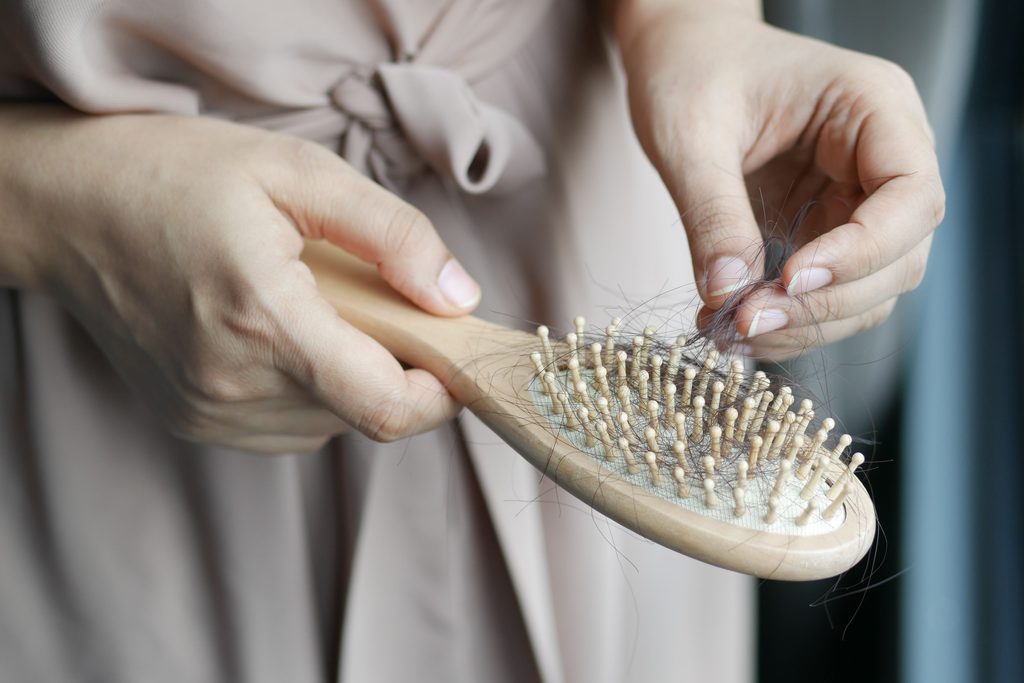
Genetics, stress, weight loss, and damaging hair habits can cause different types of hair loss in women. Androgenetic alopecia, or female pattern hair loss, is the genetically-related type of hair loss. It tends to start when women are in their 40s and 50s, usually at the back of the scalp.
If you have ever experienced substantial hair loss, where you lose hair across the whole scalp, you might have a type of hair loss called telogen effluvium. “Significant stress is one of the contributory factors for telogen effluvium,” says Dr. Luna. Women can experience telogen effluvium after giving birth, and during significant and rapid weight loss.
Putting or tying your hair up also puts you at risk for a type of hair loss called traction alopecia. “If we [tie our hair] very tightly and if we do it very often, a thinning [of hair] happens in the front,” says Dr. Luna. “Technically, it’s not a true kind of alopecia, because if you change your hairstyle and improve your habits, it will definitely get better.”
XIGLO and Belo clinics’ signature hair loss treatments MesoHair and ExoScalp can help treat or manage these types of hair loss in women. Both therapies are injectables that help support healthy hair follicles and hair growth.
“Women are more prone to insomnia, because women tend to think more, they tend to ruminate more, and because women have more social responsibilities than men,” says Dr. Chang. “Women’s brains are more hot-wired to work and to think,” which makes relaxation before sleep more challenging.
If you’re struggling with the effects of insomnia, which include low focus and energy, and increased fatigue during the day, Dr. Chang recommends getting started with a comprehensive sleep evaluation at XIGLO. “This helps us understand the circumstances around your sleep difficulties,” he says. “We identify the factors that we can reverse and correct. It is very much a personalized approach.”
At XIGLO, precision longevity is not just about adding years to life. “It’s adding health to life,” explains Dr. Kiziler. “And part of that is intimate health.”
Because every woman has her own unique needs, what precision longevity does is allow for a personalized approach to women’s health. Even the concerns that are difficult to discuss—from intimate health to hair and sleep health—can be approached with the right care and support, making them easier to address and treat.
To book a consultation at the Belo Medical Group’s XIGLO in 1 Proscenium, Rockwell call +63917-308-7790.
Share: